
Is Google's Demand Gen Worth Your Budget in 2026?

Google has never been content to let Meta own the upper funnel. In 2023, it quietly retired Discovery campaigns and replaced them with something far more ambitious: Demand Gen. By Q2 2025, Demand Gen had been extended across YouTube (including Shorts), Gmail, Discover, and Google Display — effectively giving advertisers a single campaign type that competes directly with Meta's Advantage+ on Google's own turf.
The pitch is compelling: the reach of YouTube, the targeting precision of Google's first-party data, and creative flexibility to run video, image carousels, and portrait formats all from one interface. With Google claiming a 3.7× better ROAS than paid social benchmarks, the marketing materials practically write themselves. But in 2026, with independent performance data now available across thousands of accounts, the real picture is considerably more complicated.
We've reviewed the independent research, agency test data, and Google's own documentation to give you the most honest breakdown available. Here's everything you need to decide whether Demand Gen deserves a line in your budget.
1. What Is Demand Gen?
First, a critical clarification: Demand Gen is not Discovery Campaigns with a rebrand. It's a substantively different product. Discovery campaigns were a relatively passive, keyword-adjacent tool. Demand Gen is Google's deliberate answer to Meta's creative-first, audience-driven advertising model.
Demand Gen campaigns serve across YouTube In-Stream and Shorts, Gmail, Google Discover, and the broader Google Display Network. They use Google's machine learning to identify users who are in a "consideration mindset" — browsing, researching, or being entertained — rather than actively searching for something. This is the key distinction from Search and Performance Max's search-intent targeting.
"Demand Gen is Google's most direct attempt yet to claim the consideration stage of the funnel from Meta — and for certain advertisers, it's succeeding."
— Search Engine Land, January 2026
Think of it as the upper-to-mid funnel counterpart to your Search campaigns. Where Search captures demand, Demand Gen is designed to create it — serving visually rich, high-impact ads to audiences Google predicts are likely to engage, before they've entered the search bar.
2. How It Works: Key Features Explained
🎯 Lookalike Audiences
Demand Gen introduced Google's first true lookalike audience product in 2023 — a direct lift from Meta's playbook. You upload a seed audience (customer lists, website visitors, converters) and Google builds a statistically similar audience from its first-party data pool. In 2026, these audiences are more refined, with the ability to control expansion width. Independent tests show a 22% average conversion lift when Lookalike segments are active versus interest targeting alone.
🎬 Multi-Format Creative Flexibility
Demand Gen accepts horizontal video (16:9), vertical video (9:16 for Shorts), square video (1:1), image carousels, and single static images — all within the same campaign. Google's creative preference AI automatically rotates formats based on placement and predicted engagement. This eliminates the need to run separate YouTube and Display campaigns for different creative formats, which was a major operational headache.
📍 Placement-Level Controls
Unlike Performance Max, Demand Gen allows you to opt in or out of specific placements — YouTube In-Stream, YouTube Shorts, Gmail, Discover — individually. This means you can run YouTube-only or Shorts-only if your creative is optimised for those environments. It's a rare concession to advertiser control in Google's increasingly automation-heavy ecosystem.
🛍️ Product Feed Integration
For e-commerce advertisers, Demand Gen supports Google Merchant Center product feed integration, allowing dynamic product cards to appear alongside video creative. In Q4 2025, Google expanded this to include lifestyle imagery overlays — showing your products in contextual environments rather than white-background catalogue images. Early tests show this drives a measurable CTR improvement over static product ads.
📊 Audience Signal Layering
Demand Gen supports layering Google's proprietary audience signals: In-Market segments, Life Events, Custom Intent audiences, and Customer Match. The campaign's AI uses these as guidance rather than hard restrictions — similar to how Performance Max handles audience inputs — but the signal quality tends to be higher here because of Google's massive YouTube and Gmail behavioural data.
3. The Real Performance Data (Not Google's Brochure)
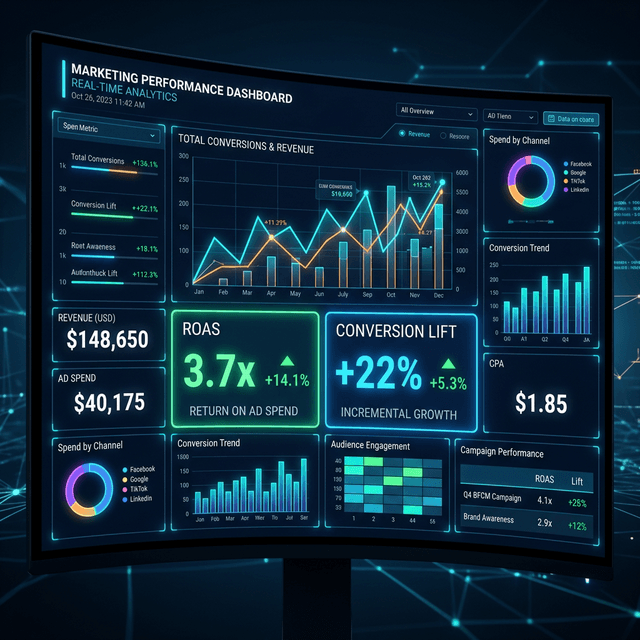
Independent analysis across thousands of accounts shows 61% of advertisers reported neutral or negative results after switching from Discovery or Meta to Demand Gen. Google's benchmark comparisons are frequently measured against weaker baselines, not best-in-class Meta Advantage+ setups.
What Google Claims
Google's official figures promise a 3.7× better ROAS compared to paid social benchmarks when Demand Gen runs alongside Search and Performance Max. For video-first campaigns on YouTube Shorts, Google cites a 40% lower CPM than comparable Meta Reels placements. The headline case studies are dramatic: Mondelēz reported a 2.3× increase in purchase intent lift. Levi's achieved a 66% reduction in CPA running Demand Gen video alongside Search.
What Advertisers Actually Experience
The independent picture is more uneven. Agency benchmarking across B2C accounts in 2025 found that Demand Gen consistently underperforms Meta Advantage+ when creative quality is controlled for — meaning when you bring the same production-quality video to both platforms, Meta's algorithm tends to extract more conversion value from it. Where Demand Gen does win is on YouTube In-Stream CPMs, which are structurally lower than Meta's video placements in most verticals.
A recurring complaint from real-world testers: the Lookalike Audience feature, despite being Demand Gen's flagship targeting innovation, frequently expands far beyond the intended segment once campaign spend scales. Advertisers running tightly controlled seed lists of high-LTV customers report the algorithm drifting toward broader, lower-intent audiences within 3–4 weeks — a phenomenon Meta advertisers have dealt with for years.
ROAS vs. Social
Quality Meta Setup
CPM vs. Meta Reels
CPM Advantage
4. Honest Pros & Cons
Placement-Level Control
Unlike PMax, you can isolate YouTube Shorts, In-Stream, Gmail, and Discover independently — a genuine competitive advantage for creative-specific testing.
Lookalike Audience Access
Google's first real lookalike product, leveraging YouTube and Gmail behavioral data for audience expansion that wasn't previously available in Search or Display.
Multi-Format in One Campaign
Video, carousel, and image formats in a single campaign reduces operational overhead significantly, especially for lean teams managing multiple channel formats.
Lower YouTube CPMs Structurally
YouTube In-Stream and Shorts CPMs are consistently lower than Meta's video placements, making it a viable lower-cost video channel even when ROAS is modest.
Lookalike Audience Drift
At scale, Demand Gen's algorithm tends to expand far beyond tight seed audiences within weeks, eroding targeting precision and conversion quality simultaneously.
Weaker Signal Than Meta
Google's behavioural graph is strong, but Meta's social signals and real-time interest data still outperform for direct-response consumer purchases at equivalent budgets.
Creative Dependency
Demand Gen rewards high-production video creative. Without strong video assets — ideally native vertical formats — CPMs inflate and engagement rates collapse.
Attribution Challenges
Gmail and Discover placements are difficult to attribute accurately. View-through attribution inflates apparent ROAS; last-click measurement undervalues real impact.
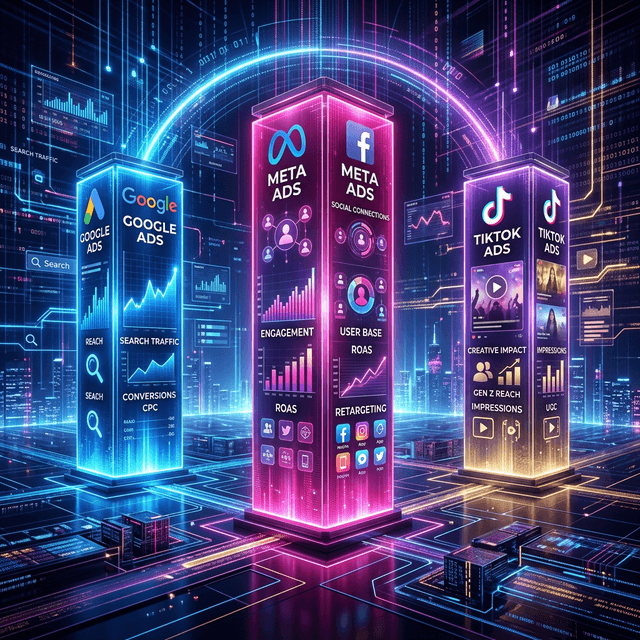
5. Demand Gen vs. Meta Ads vs. Performance Max
| Feature | Demand Gen | Meta Advantage+ | Performance Max |
|---|---|---|---|
| Campaign Type | Upper/mid-funnel awareness | Full-funnel social | Cross-channel conversion |
| Placement Control | ✔ Channel-level | ⚡ Placement exclusions | ✘ Minimal |
| Lookalike Audiences | ✔ Native | ✔ Native | ⚡ Audience signals only |
| Creative Formats | Video, carousel, image | Video, image, carousel, stories | All asset types |
| Best For | YouTube-first brands, D2C | Direct response, e-commerce | Full-funnel conversion |
| CPM Competitiveness | ✔ Strong on YouTube | ⚡ Higher, but higher intent | ⚡ Variable by channel |
For 2026, most sophisticated advertisers are not choosing between these three — they're running all of them in tandem. The recommended architecture is Demand Gen for upper-funnel video and consideration (20–30% of budget), Meta Advantage+ for direct-response social (30–40%), and Performance Max handling conversion campaigns (40–50%). Whether this three-platform strategy makes sense depends entirely on your creative bandwidth, team capacity, and budget scale.
6. Who Should (and Shouldn't) Use It
✓Strong Candidates
- →D2C brands with strong video creative assets — particularly vertical formats already produced for TikTok or Instagram Reels that can be repurposed for YouTube Shorts.
- →Advertisers who have maxed out Meta's audience scale in their niche and are looking for incremental reach with different behavioral signals.
- →Brands with large Customer Match lists (10,000+ matched users) where Lookalike Audience quality will be sufficient to generate meaningful signal.
- →E-commerce accounts with Merchant Center product feeds who want dynamic product ads with lifestyle imagery on YouTube and Discover simultaneously.
×Think Carefully If...
- →You don't have proper video creative. Static image-only Demand Gen campaigns routinely underperform equivalent Display or Meta campaigns — the product is built around video.
- →Your conversion attribution model relies on last-click. Demand Gen's upper-funnel placements will look terrible in last-click; you need data-driven or position-based attribution to measure it honestly.
- →You're a small team without bandwidth to monitor creative performance weekly. Demand Gen's creative rotation requires active management to prevent fatigue from destroying CPMs.
- →Your seed audiences are too small. Lookalike models need meaningful signal. Fewer than 1,000 matched seed users produces unstable, low-quality lookalike expansion that wastes budget fast.
7. How to Test It the Right Way
If you decide to give Demand Gen a genuine trial, the temptation is to simply enable it and watch. Resist. Here's a methodical five-step framework that maximises your chance of getting real signal rather than noise.
Demand Gen is only as good as your creative assets. Audit what you have: native vertical video (9:16) for Shorts, horizontal video (16:9) for In-Stream, and at least 3–5 image variants for carousel and Discovery placements.
Do not launch Demand Gen with last-click attribution still active. Switch to data-driven attribution (DDA) at the account level minimum. Demand Gen's impact is primarily view-through and assisted — measuring it on last-click will lead you to incorrectly kill campaigns.
Upload your highest-LTV customer list as your seed audience before activating Lookalike expansion. Set lookalike similarity to "narrow" initially — resist the algorithm's urge to expand broadly. You want quality signal before scale.
Start with YouTube Shorts placement only, not the full Demand Gen placement mix. Shorts offers the most structured creative environment, the best CPM efficiency, and the cleanest performance signal.
Demand Gen creative fatigue is faster than Meta — particularly on YouTube Shorts. Build a creative refresh cycle into your workflow: new hooks, new visual treatments, new CTAs on a 4-week rotation.
Demand Gen Is a Solid Second Channel — Not a Meta Replacement
Google's Demand Gen is a powerful tool for brands with mature video creative and a need for incremental reach beyond Meta. It structural advantages on YouTube structure structurally offer structural lower CPMs, but its targeting precision still trails Meta's direct-response powerhouse. For most accounts in 2026, Demand Gen belongs as a mid-to-upper funnel supporter rather than a primary direct-response driver. Run the experiment on Shorts first, monitor your attribution model closely, and refresh creative aggressively to find success.
Final Thoughts: The Bigger Picture
Demand Gen represented Google's attempt to reconcile its massive reach with Meta's audience-first philosophy. It's a window into the future of creative-driven automation, where the advertiser's value shift from managing keywords to producing high-impact assets that feed the machine learning system. Winners in 2026 won't be the advertisers who blindly scale; they'll be the ones who understand how to feed the right creative to the right AI placement at the right structural price.
"The most successful marketers in 2026 recognize that AI isn't a strategy — it's an accelerator for great creative and high-quality first-party data."
— Industry Consensus, 2026